Q1: What is a silicone thermal pad and how does it work?
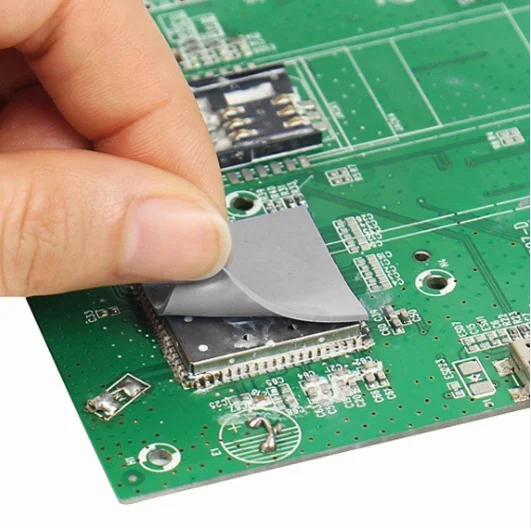
A silicone thermal pad is a pre-cured, solid interface sheet filled with heat-conductive ceramics. It works by filling microscopic air gaps between hot components and heat sinks, forming a flexible, seamless thermal bridge that lowers interfacial resistance.
Q2: Can I use a thermal pad to replace traditional thermal paste or grease?
Yes. While paste fits ultra-thin gaps, solid pads offer much cleaner installation, reliable electrical insulation, and zero risk of drying out, pumping out, or leaking over long-term operations.
Q3: What core parameters should I confirm when selecting a thermal pad?
To select the perfect thermal pad for your assembly, you should always define three primary specifications: your target thermal conductivity, the physical gap thickness, and the required hardness level.
Q4: Does Volsun support custom shapes, and what is your standard sample size?
Yes, we offer full precision die-cutting for any custom geometry or screw-hole pattern based on your blueprints. Our factory's standard production testing sheet size is 235 by 235 millimeters.
Q5: What range of thermal conductivity can Volsun customize?
To match various performance requirements and budgets, Volsun customizes and manufactures a complete, scalable line of silicone thermal pads ranging from a baseline of 1.5 W/m·k up to 6.0 W/m·k.
Q6: Are Volsun silicone thermal pads suitable for high-voltage applications?
Absolutely. Our pads act as high-performance electrical insulators, featuring a strong dielectric breakdown voltage exceeding 6 kV and a high volume resistivity to prevent dangerous short circuits and electrical arcing.
Q7: What thickness options are available for your thermal pads?
We manufacture customized thicknesses spanning from 0.5 mm up to 5.0 mm. We generally recommend selecting a thickness slightly greater than your mechanical gap to ensure optimal compression and air exclusion.
Q8: Are these thermal pads useful for lithium battery pack thermal management?
Yes, they are widely used in EV and ESS battery packs to transfer heat from cells to liquid cooling plates. They maintain critical temperature uniformity while absorbing road vibration and mechanical shocks.
Q9: What is the official fire retardancy and flame rating of your pads?
Safety is built-in; the entire Volsun silicone thermal pad series achieves the highest industry standard of a UL94 V-0 flame rating, ensuring the material self-extinguishes instantly and won't propagate fire.
Q10: What operational temperature range can your silicone thermal pads withstand?
Our materials retain their full thermal performance and physical elasticity across an expansive environmental window from minus 40 degrees Celsius up to a continuous operating temperature of plus 200 degrees Celsius.
Q11: Do your thermal pads comply with international environmental standards?
Yes, all Volsun thermal pads undergo strict quality testing and fully comply with global environmental mandates, including RoHS and REACH regulations, guaranteeing they are completely free of restricted hazardous substances.
Q12: How soft are these pads, and what scale is used to measure them?
Our pads are highly compliant and range from 45 to 70 Shore OO in hardness. This extreme softness allows them to conform to uneven surfaces perfectly without placing damaging stress on delicate PCBs.
Q13: What testing standards does Volsun use to verify product metrics?
We verify our baseline technical values using standard ASTM international methodologies, including utilizing the globally recognized ASTM D374 testing protocol specifically for measuring product thickness.
Q14: How should the thermal pads be stored, and what is their shelf life?
Store them in a clean area at 20 to 30 degrees Celsius with relative humidity under 80 percent. Under these controlled conditions, they provide a stable shelf life of 12 months from production.
Q15: How can I request evaluation samples from Volsun?
Contact our technical team directly via email or our website. Simply provide your specific application, required dimensions, and target thermal conductivity, and we will prepare tailored evaluation samples for your prototyping.
 Popular FAQs
2026-08-14
2026-07-24
2026-06-12
2026-06-05
2026-06-01
2026-05-22

Welcome to Volsun, a professional insulation protection products manufacturer! We provide IP68 cold shrink tube, fiberglass sleeve, heat shrink tube and silicone thermal conductive products.
No.402, Mudong Road, Wuzhong District, Suzhou, Jiangsu 215101
Copyright © Suzhou Volsun Electronics Technology Co., Ltd All Rights Reserved.
 EN
EN