 EN
EN


How To Solve Motor Bearing Electrical Erosion
What causes shaft voltage in motors operated by Variable Frequency Drives (VFDs)? How can bearing currents be tested?
Source of Bearing Currents
Bearing currents are high-frequency discharge currents driven by shaft voltage and flowing through motor bearings. The root cause lies in the pulse width modulated (PWM) voltage generated by VFDs, which outputs a series of rapidly switching positive and negative pulses rather than a sinusoidal wave. This creates an unbalanced average voltage across the three phases, known as common-mode voltage (often appearing as a six-step square wave).
In VFD-driven motors, the common-mode voltage induces shaft voltage through capacitive coupling within the motor's internal structure. Once this voltage exceeds the insulation strength of the bearing lubricant film, it discharges, forming capacitive EDM (Electrical Discharge Machining) currents that create micro-pits and fluting on the bearing raceways. In higher-power motors (typically >75 kW), high-frequency magnetic flux also induces shaft-end voltage, leading to high-frequency circulating currents that simultaneously damage bearings at both ends. These two types of currents are the primary causes of electrical bearing damage.
Capacitive Electrical Discharge Machining Currents
The internal structure of an electric motor functions similarly to a capacitor. The common-mode voltage from the VFD generates a capacitively coupled voltage on the motor shaft. This shaft voltage discharges through arcing across the bearings to the motor frame, constituting capacitive EDM currents.
Shaft voltage can be measured using a digital oscilloscope and a VOLSUN Shaft Voltage Probe. Discharges manifest as high-frequency voltage spikes.
These discharge arcs, which can occur tens of thousands of times per second, degrade bearing grease and cause electrical discharge machining, resulting in thousands of microscopic pits on the bearing raceways. These pits, along with degraded grease, increase friction and lead to NVH (Noise, Vibration, and Harshness) issues.
High-Frequency Circulating Currents
High-frequency currents in the VFD output capacitively couple to the motor frame and travel through it seeking ground. As these currents flow through the frame, they generate high-frequency magnetic flux inside the motor. This flux, in turn, induces a high-frequency end-to-end voltage on the shaft. In larger motors, the end-to-end shaft voltage is sufficiently high to drive high-frequency circulating currents through the bearings.
This circulating current flows from the shaft to the frame via one bearing and from the frame back to the shaft via the other. The result is a circulating current loop between the shaft and motor frame, damaging both bearings simultaneously.
Effects of Bearing Currents
Over time, the microscopic pits caused by arcing through the bearings accumulate into a visible matte finish known as frosting. A frosted bearing is less smooth than a healthy one, leading to increased friction, higher heat generation, and further degradation of the bearing raceways. Over time, the interplay between electrical damage and vibration produces a striped or "picket fence" pattern known as fluting.
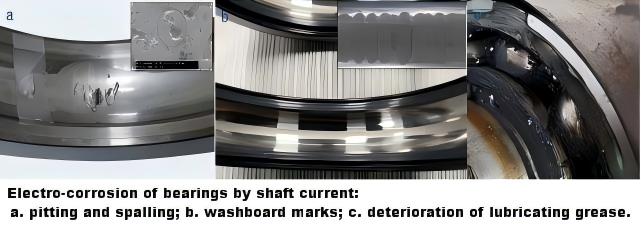
Once fluting develops, bearing failure is imminent. A fluted bearing causes excessive vibration and a characteristic shrieking noise. The diagram below illustrates common types of bearing electrical erosion.
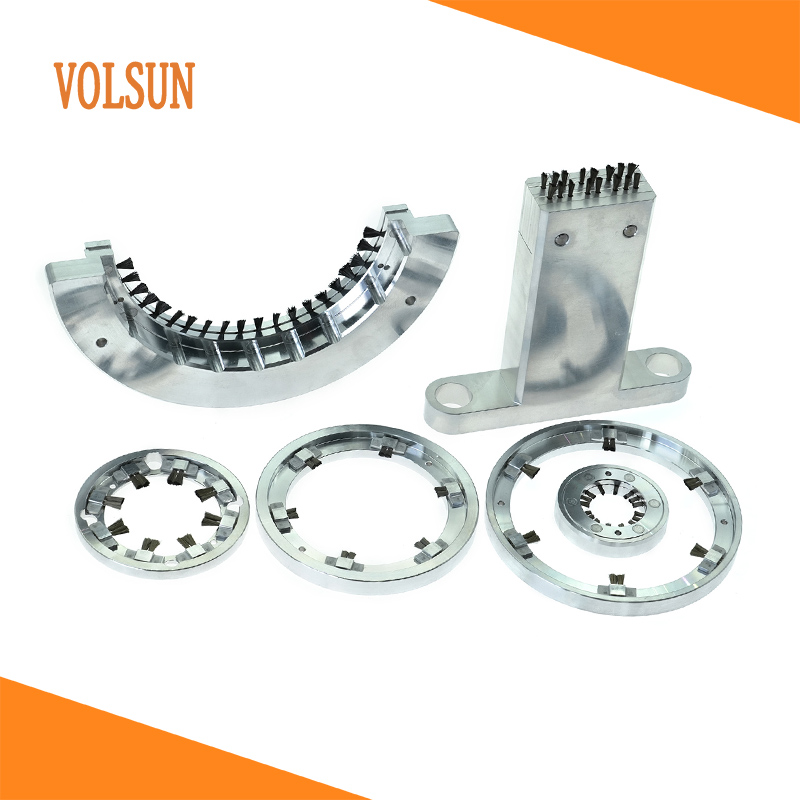
VOLSUN's 3rd Generation Conductive Ring (Shaft Grounding Ring), with its lightweight design and compact structure, can be directly installed on bearing units, meeting the stringent space and weight requirements of electric vehicles. Additionally, its maintenance-free feature reduces after-sales service pressure, making it a reliable solution for addressing bearing electrical erosion issues!