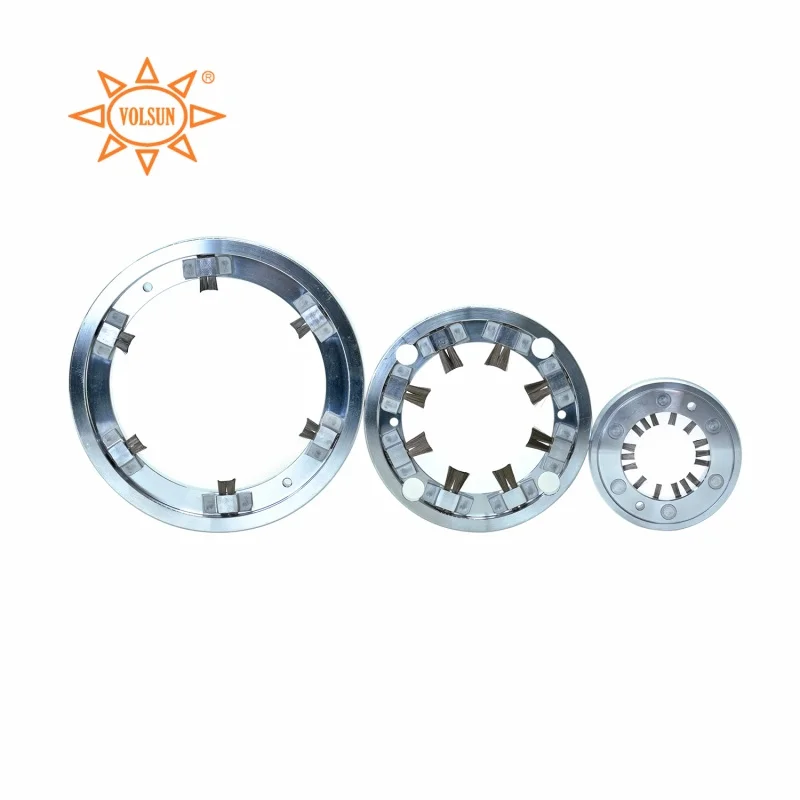
A shaft grounding ring is installed on a motor shaft to safely discharge unwanted electrical currents, preventing them from passing through the bearings and causing electrical erosion, which significantly extends motor service life.
Shaft voltage is typically generated by VFD switching, electromagnetic imbalance, and static charge buildup; once the voltage exceeds the lubricant film strength, it discharges through the bearings, creating damaging shaft currents.
There is no universal safe value, as risk depends on speed, lubrication, and operating conditions; even relatively low voltage can cause cumulative damage over time if repeated discharges occur.
It is recommended for VFD-driven motors, high-speed applications, medium to high voltage systems, or any critical equipment where bearing reliability and long service life are important.
It uses conductive microfibers to maintain continuous contact with the shaft, providing a low-resistance path that diverts harmful current directly to ground instead of through the bearings.
The ring should be installed as close as possible to the bearing to ensure the most effective current diversion and minimize the risk of current passing through the bearing.
The most important indicators include dynamic contact resistance, shaft voltage reduction capability, and wear resistance, with dynamic contact resistance being the most critical for real-world performance.
Grounding rings are typically installed using press-fit or mechanical fastening methods, and proper alignment and secure contact are essential for consistent performance.
A typical press-fit force ranges from 2000 to 6000 N, depending on shaft size and design, ensuring the ring remains secure without damaging components.
Typically, in accordance with automotive industry standards—which stipulate a service life of 300,000 kilometers or 15 years—the wear resistance of oil-cooled motors extends well beyond 300,000 kilometers. For specific details, please consult with our technical staff.
Replacement is only necessary if there is significant fiber wear, visible damage, or a noticeable increase in resistance that affects grounding performance.
In high-power or high-voltage applications, combining a grounding ring with insulated bearings is recommended to fully block circulating currents and provide maximum protection.
One grounding ring can provide basic protection, but installing rings on both ends improves effectiveness; however, for large motors, combining with insulated bearings is still the best solution.
They can be used in both oil and water-cooled motors, although oil environments generally result in less wear, while water-cooled systems may require more durable designs.
Selection should consider shaft size, installation space, motor voltage, operating environment, and expected lifespan to ensure proper fit and reliable performance.
Yes, grounding rings can be customized in size, structure, and materials to meet specific application requirements, typically with relatively short lead times.
 Popular FAQs
2026-08-14
2026-07-24
2026-06-12
2026-06-05
2026-06-01
2026-05-22

Welcome to Volsun, a professional insulation protection products manufacturer! We provide IP68 cold shrink tube, fiberglass sleeve, heat shrink tube and silicone thermal conductive products.
No.402, Mudong Road, Wuzhong District, Suzhou, Jiangsu 215101
Copyright © Suzhou Volsun Electronics Technology Co., Ltd All Rights Reserved.
 EN
EN